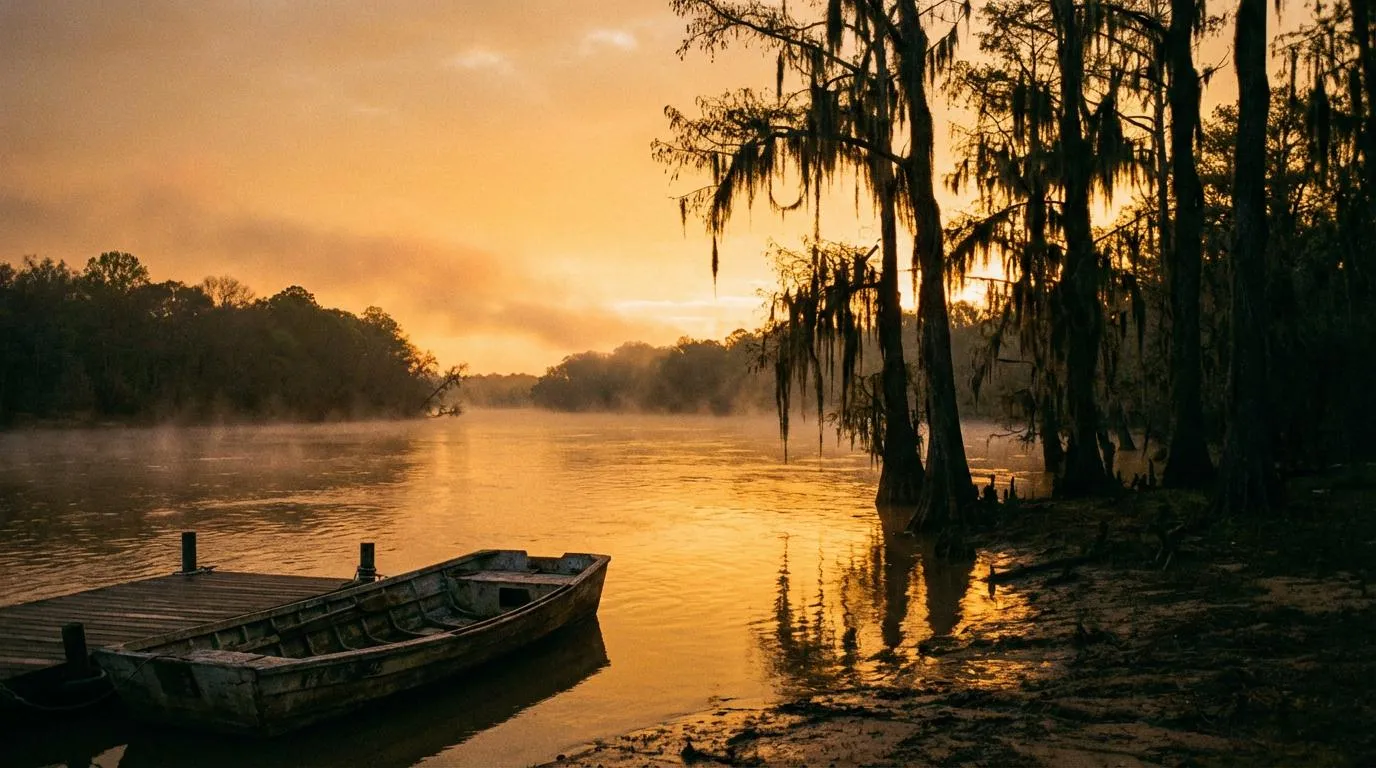
Fayetteville is the kind of college town that sneaks up on you. You come expecting stadium banners and pizza chains and leave having drunk too many Arkansas craft beers in a bar that's been open since 1927, in a city where the Civil War dead still lie in a cemetery a few blocks from the campus gates. The University of Arkansas gives Fayetteville its energy, but the Ozark hills give it its soul — that slightly vertiginous feeling of a landscape that keeps its own counsel, where the hollows run deep and the music coming out of them sounds ancient even when it's new.
This is one of the Big Muddy's northernmost stops, the place where the corridor connecting the Delta to the hill country arrives at the base of the Ozarks proper. Louis Jordan — the Arkansas-born proto-rock and roller, one of the most important musicians America ever produced — lived in these rhythms. Sonny Boy Williamson came from the same soil. And in the 1950s and early 1960s, at a club called the Rockwood, Jerry Lee Lewis and Roy Orbison and a young band that would eventually become The Band played to Fayetteville crowds who barely knew they were witnessing the future of American music.
The city has Civil War echoes, creative tumult, and the particular electricity of a place with sixty thousand students and one hundred years of juke-joint tradition. That combination produces something.
Where to Stay
Inn at Carnall Hall — A 1905 residence hall for the University of Arkansas's first women students, now a boutique hotel on the edge of campus that carries its history with grace and offers it to guests without apology. The rooms are handsomely finished. The location, walking distance to Dickson Street and the Fayetteville square, is exactly where you want to be. $148–$349. 465 N Arkansas Ave, Fayetteville, AR.
Pratt Place Inn — On a wooded estate outside the city, this luxury B&B operates in the register of the English country house — multiple rooms and cottages, manicured grounds, the kind of deep quiet that the forest provides when there's enough of it. For the traveler who wants Fayetteville's cultural richness and the opposite of Dickson Street's noise. $234–$676. 2231 W Markham Rd, Fayetteville, AR.
Stay-Inn-Style B&B — A historic bungalow on Rock Street furnished with antiques and the kind of considered comfort that comes from an owner who thought hard about what a guest actually needs. Affordable by Fayetteville standards, genuine by any standard, and within walking distance of the music and the food. $95–$115. 117 W Rock St, Fayetteville, AR.
Where to Eat
Hugo's — A Block Avenue institution that occupies the sweet spot between bar and restaurant without committing fully to either, which turns out to be exactly the right call. The American classics are executed with a kitchen's worth of care — the burgers are serious, the atmosphere is lived-in, and the low-lit room on a weeknight has the comfortable energy of a place where the regulars actually like being there. $$–$$$. 25 1/2 N Block Ave, Fayetteville, AR.
Hammontree's Grilled Cheese — The proposition sounds simple. What arrives is not simple. Hammontree's has turned the most humble of American sandwiches into a vehicle for genuine creativity — combinations that shouldn't work and do, a rotating menu that rewards repeat visits, and a commitment to quality that makes every grilled cheese feel like a considered act of cooking rather than an afterthought. $$–$$$. 326 N West Ave, Fayetteville, AR.
Penguin Ed's BBQ — South Arkansas BBQ traditions interpreted in the Ozark foothills, which means the smoke is real and the competition is the forty years of Arkansas pitmasters who came before. The pulled pork is the benchmark. The ribs are the argument. The sides — baked beans, slaw, corn on the cob — are the kind that BBQ joints produce when they're paying attention. $$–$$$. 230 S East Ave, Fayetteville, AR.
Where to Hear the Music
George's Majestic Lounge — Arkansas's oldest standing music venue, open since 1927 on West Dickson Street, and the kind of place that earns its legend by continuing to deserve it. The stage is small enough that no seat is bad. The booking has always leaned toward the interesting rather than the safe — all genres, but with a consistent preference for musicians who mean it. Jerry Lee Lewis played here. Whoever's playing tonight is working in that tradition. A sacred site on the expanded Big Muddy map. 519 W Dickson St, Fayetteville, AR.
Tin Roof — The eclectic counterpart to George's — daily live music ranging from regional bands to DJ nights, an outdoor component that Fayetteville's climate occasionally cooperates with, and the inclusive energy of a room that doesn't have a type. Whatever's happening tonight, the Tin Roof is going to find a way to make it feel inevitable. 430 W Dickson St, Fayetteville, AR.
Kingfish — The dive bar as it was meant to be: local bands, outdoor patio, the kind of beer-and-wood smell that comes from years of both, and a crowd that walked from the neighborhood rather than Ubered from a hotel. Fayetteville has a genuine music scene that lives below the tourist-facing venues, and Kingfish is where that scene holds its own on a Thursday night. 262 N School Ave, Fayetteville, AR.
Fayetteville is where the Big Muddy climbs into the hills and changes register — not quieter, exactly, but more internally complex, the way hill country music has always been more layered than people from the flatlands expect. You carry George's and the Ozark light with you when you leave. Head northwest toward Bentonville, or turn back south toward Little Rock and the Delta. The hills will follow you either way.